Cancellation & Flexible Booking Policy Explained
 Services
Every hotel cancellation policy munnar properties publish says roughly the same thing in roughly the same language, and almost nobody reads it until something has already gone wrong. This page explains the shape of ours in plain terms: how notice periods work, what a deposit does, why peak dates are stricter than the rest of the year, how group bookings differ, and what happens when the weather rather than your plans causes the problem. The exact terms for your dates are confirmed when you book, and the whole point of booking direct is that any of it can be discussed with a person.
Key Takeaways
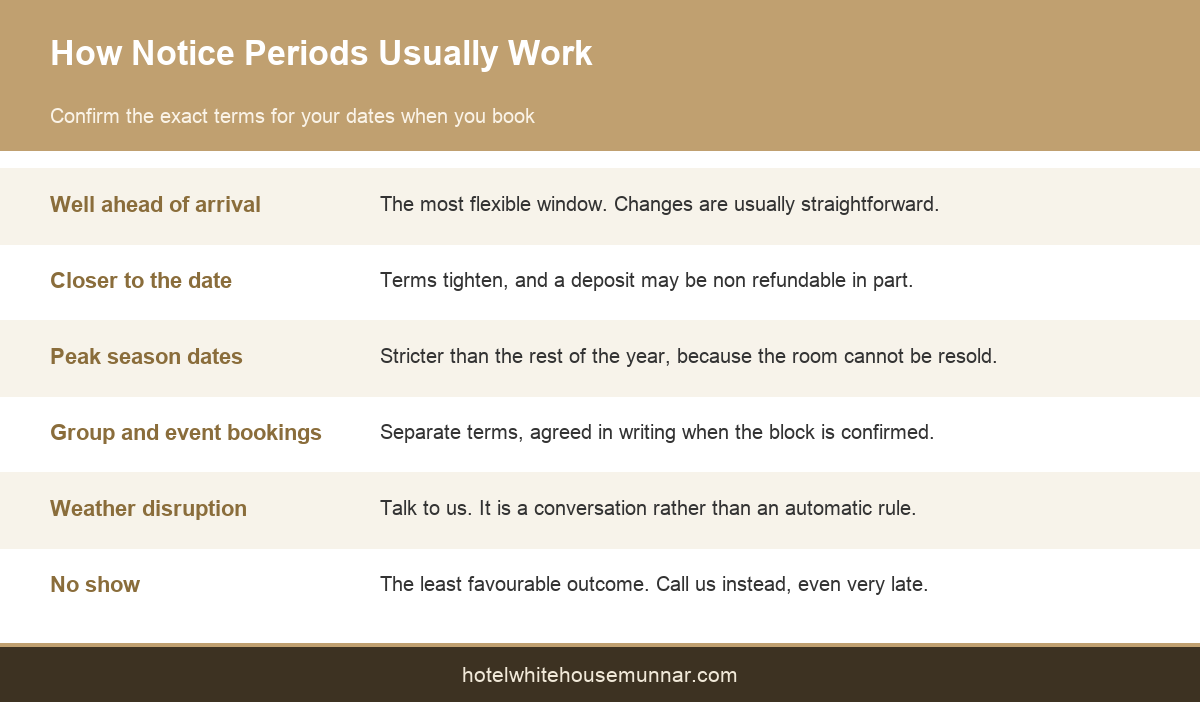
- Notice is the main variable; the earlier you tell us, the more flexible the outcome.
- Peak season dates carry stricter terms because a late cancellation cannot be resold.
- Group and event bookings have separate terms agreed in writing when the block is confirmed.
- Weather disruption is a conversation with us rather than an automatic rule.
How Notice Periods Work
Cancellation terms are almost always a function of how much notice you give. Well ahead of arrival, a change is straightforward. Close to the date it is not, because the room can no longer realistically be resold.
That is the whole logic and it is worth understanding rather than memorising a table. A property four hours from an airport does not get walk in guests filling a room cancelled at six in the evening.
The exact windows and any deposit terms are confirmed at the time of booking. Ask for them in writing rather than assuming a standard, because they differ by season.
Our direct booking pillar covers the wider process of booking with us and what happens after an enquiry.
Why Peak Dates Are Stricter
The last two weeks of December and the main wedding season carry tighter terms across the whole region, and often a minimum night stay as well.
The reason is simple availability. A room released in mid December is genuinely resellable; the same room released on 28 December almost certainly is not, because everyone who wanted those nights booked months earlier.
Our festive season write-up covers what that period involves and why the booking window closes so much earlier than most guests expect.
If flexibility matters more than the peak weather, the shoulder months in our month-by-month climate note are considerably easier on every count.
Changing Rather Than Cancelling
Moving dates is usually easier than cancelling and is the first thing to ask about. Whether it is possible depends on availability in the new window rather than on the policy alone.
This is where a direct booking is materially better than one through an intermediary. It is one conversation with the people who own the decision rather than a ticket in a queue, as our write-up on why direct beats an OTA explains.
Tell us early. A change requested three weeks out is a different conversation from the same change requested three days out, and the difference is entirely in what we can still do about the room.
Message the front desk rather than waiting to see whether the plan resolves itself.
Weather, Roads and Things Nobody Controls
Kerala's monsoon is predictable as a season and unpredictable as a day. Landslip closures and significant delays on the climb do occur between June and August, as our note on the wet months sets out.
If travel disruption prevents you reaching us, talk to us rather than assuming the worst. It is a conversation rather than an automatic rule, and it is one of the situations where booking direct is worth the most.
Call even if you are already late. A guest who rings from the road at nine in the evening is in a far better position than one who does not arrive and does not call.
Building slack into travel days removes most of this risk in the first place. Our table of driving distances gives figures honest enough to plan around.
Groups, Events and Deposits
Group and event bookings work differently and have their own terms, agreed in writing when the block is confirmed rather than taken from a standard policy.
A held block is not a booking. It becomes one when the deposit is paid, and it lapses if that does not happen by the agreed date, which our guide to booking many rooms at once explains in detail.
Release dates matter for a block: the point at which unallocated rooms go back into general sale. Agree that date explicitly rather than leaving it implied.
For a wedding or a function, the terms usually cover the event as well as the rooms. Our events space guide covers what to settle and when.
Conclusion
The principle behind all of it is straightforward: the earlier you tell us, the more we can do. Ask for the exact terms in writing when you book, take the flexible option if your plans are genuinely uncertain, and pick up the phone rather than sending nothing if something changes at short notice. On weather disruption in particular, talk to us before assuming an outcome. Our contact page has the direct routes, and our note on what a rate covers explains what you are actually paying for.
Frequently Asked Questions
Why are peak dates stricter?

What is the cancellation policy?
Can I change my dates instead of cancelling?
What if the roads are closed by weather?
What happens if I do not arrive and do not call?
Do group bookings have different terms?
Is the deposit refundable?
Should I book the flexible rate?