Banquet Hall and Event Venue in Munnar: The Complete Planning Guide
 General
Choosing a banquet hall and event venue munnar planners can actually work with means accounting for things that do not arise at a city venue. Guests arrive across a four hour drive rather than a twenty minute one, the weather can close an outdoor plan at an hour's notice, and the same rooms your guests are sleeping in are the constraint on how many people you can invite. None of that is a problem if it is planned for and all of it is a problem if it is not. This guide covers capacity, season, catering, logistics and the specific things a hill location changes about running an event.
Key Takeaways
- Room availability, not hall capacity, is the real limit on your guest count.
- Book six months out for the December window and for wedding season dates.
- Every outdoor element needs an indoor fallback agreed in advance, not on the day.
- Guests arrive across a long drive, so build the arrival pattern into the schedule.
What Kind of Event Works Here
The events that suit a hill property are the ones where the setting is part of the point: a reception rather than a large wedding, a company offsite rather than a conference, a family reunion rather than a party.
Scale is the honest constraint. A venue like this does an event of a few dozen people exceptionally well and an event of several hundred not at all, and it is better to know that before the invitations go out.
The strongest use case is a multi day gathering where the venue is also where everyone sleeps and eats. That removes transport between sessions and turns the evenings into part of the event rather than an interval.
Our facilities write-up covers the hall alongside the other facilities, and the on-site amenities page has the current detail.
Capacity Is a Rooms Question
The first thing most organisers get wrong is treating hall capacity and event size as the same number. At a city venue, guests go home. Here, they stay, and the property has a finite number of rooms.
So the practical sequence is: work out how many rooms you can hold, multiply by realistic occupancy, and that is your guest ceiling for a residential event. Our write-up on room layouts by group size and the suite grade comparison are the references for that arithmetic.
For a non residential event where guests drive up and back the same day, the maths is different but the drive is brutal. Four hours each way is a great deal to ask of anyone for a single evening.
Block the rooms first, before anything else. Our guide to booking many rooms at once covers how that process works.
Season, and the Dates That Disappear First
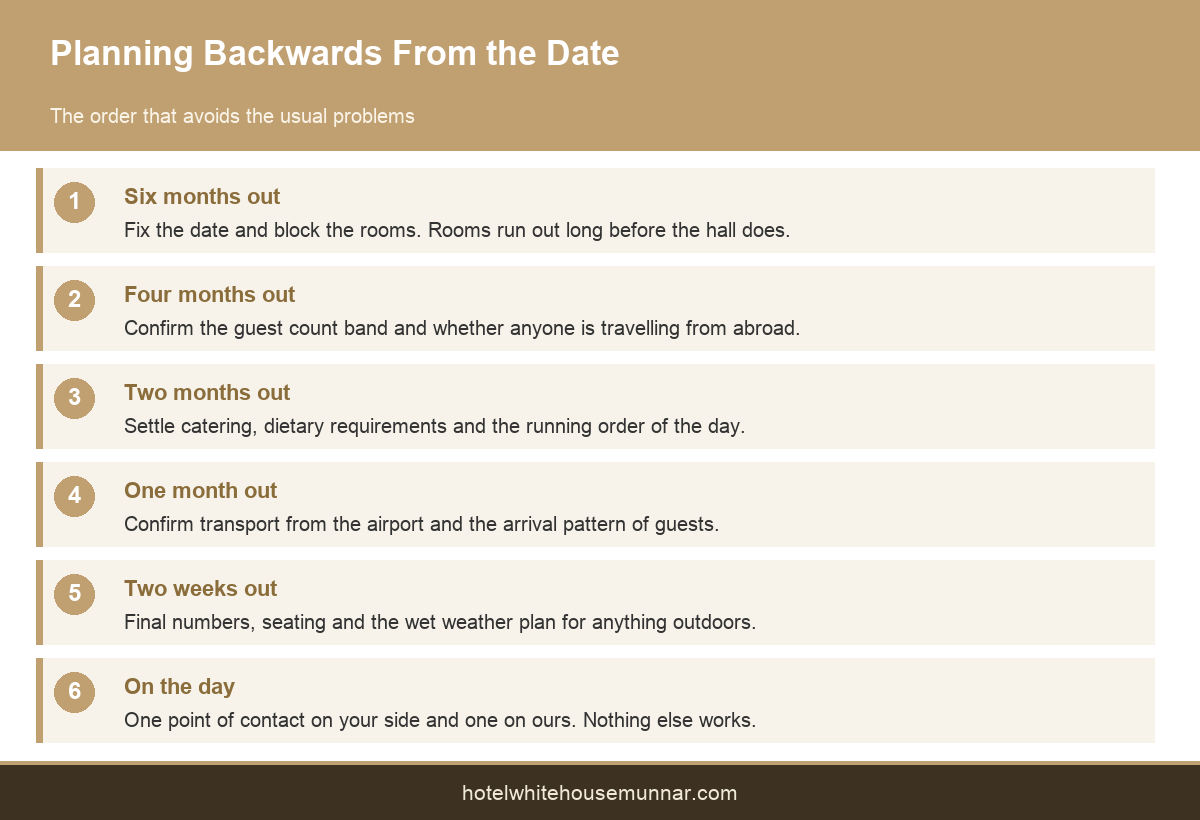
The December window and the main wedding season are the two periods where dates go earliest, and both need six months of notice rather than three.
Weather matters more than at a city venue because so much of the appeal is outdoors. From September to March that is reliable; from June to August it is not, as our note on the wet months explains.
There is a strong argument for the shoulder months. Late September, October and early March give good weather, real availability and lower rates, which for a large group is a substantial difference. Our month-by-month climate note has the detail.
Festival dates are their own category. The harvest festival and the year end period both come with their own programming, covered in our festival write-up and the festive season write-up.
Catering
For a group event the kitchen is doing something different from normal service: one sitting, one timing, a fixed menu and a known headcount. That is easier than a la carte if it is planned and much harder if it is not.
Settle the menu two months out and the dietary requirements with it. Vegetarian needs no arrangement here, but vegan, Jain and allergies do, as our meat-free options note sets out.
A traditional feast served on a banana leaf is the obvious set piece for a Kerala event and needs planning rather than a phone call. Our regional food guide describes what it involves.
The wider range the kitchen can draw on is in our menu write-up, which matters for multi day events where the same group eats here three nights running.
Getting Everyone Here
Transport is the single most underestimated part of a hill event. Guests will arrive across a four hour drive from Kochi, or longer from Bengaluru, and they will not all arrive together.
Plan the arrival window rather than an arrival time. Our route guide up from the coast and the table of driving distances give the honest figures to put in an invitation.
Group transport from the airport is worth arranging centrally rather than leaving to individuals. Two or three vehicles running to a schedule beats fifteen separate taxis arriving across six hours.
Build the first evening as arrival rather than programme. Anyone who has just done that drive is not at their best, and treating it as a settling-in dinner works far better than a formal opening.
The Weather Plan
Every outdoor element needs an indoor equivalent agreed in advance. Not sketched, agreed: which room, what capacity, how long it takes to turn around, and who decides.
Set a decision time. Around five in the evening for a dinner, mid morning for an afternoon session. A decision made calmly at five is fine; the same decision at seven is chaos.
Cloud here arrives without much warning and often passes as quickly. The mistake is treating a shower as a catastrophe rather than a twenty minute delay, and that only happens when there is no plan.
From June to August, plan indoors as the default and treat outdoors as the upgrade. It inverts the usual thinking and it removes almost all the risk.
Running the Day
One point of contact on your side and one on ours. Every event that goes wrong at a venue like this goes wrong because six people were giving instructions and none of them knew what the others had asked for.
Share the running order in writing a fortnight ahead, including the things that seem obvious. When the food goes out, when the speeches happen, when the music stops, and who is allowed to change any of it on the day.
Build slack into the schedule. Everything at altitude takes slightly longer, guests wander off to look at the view, and a plan with no gaps in it will not survive the afternoon.
Give guests something to do between the formal parts. The list in our round-up of what is nearby covers short outings that fit a free morning.
Which Kind of Event, and Where to Read Next
For a company gathering, the useful framing is a retreat rather than a conference: sessions in the morning, something outdoors in the afternoon, and dinner as the actual point. Our offsite planning guide covers that in detail.
For a family gathering across generations, the constraints are room layouts and walking distances rather than agenda. Our reunion planning guide and the accessibility write-up deal with those.
For a wedding reception, the decisive questions are guest count against room availability, and the weather plan. Our wedding write-up works through both.
For a birthday, an anniversary or a smaller private celebration, the hall is often the wrong room entirely and a private table is the right one. Our celebration write-up and private table write-up cover that end of the scale.
Conclusion
A hill venue rewards planning and punishes improvisation more than a city one, because the drive is long, the weather moves and the rooms are finite. Work backwards from the date: block rooms six months out, fix the guest count against room availability rather than hall capacity, settle catering and dietary requirements two months out, and agree a weather fallback with a decision time attached. Then name one person on each side and let them run it. Talk to us about your date early and the rest becomes straightforward.