Places to Visit Near Hotel White House Munnar
 General
Staying at Hotel White House Munnar in Anachal puts you close to some of the best natural attractions in Kerala, from wildlife parks to sunrise viewpoints and working tea and spice estates. This guide brings together the places to visit near Hotel White House Munnar that our own guests ask about most, with honest notes on distance, timing and what each stop is actually like, so you can build a trip that matches how much walking, driving and early rising you are up for. Whether you have two nights or a full week, this guide is built to help you choose without guesswork.
Key Takeaways
Everything in this guide sits within roughly 30 minutes to 1 hour 30 minutes of the property in Anachal.
Wildlife and sunrise spots, Eravikulam and Kolukkumalai, reward an early start more than any other stops on this list.
Tea and spice estates, plus Mattupetty Dam, make easier half day options for families or a slower travel pace.
In this guide
Eravikulam National Park
Top Station
Kolukkumalai Sunrise Trek
Mattupetty Dam and Echo Point
Munnar Tea Garden Tours
Spice Plantation Tours
Waterfalls Near Munnar and Anachal
Planning Tips: Building Your Own Munnar Itinerary
Eravikulam National Park
About 45 minutes from the property, Eravikulam National Park protects the largest population of the endangered Nilgiri tahr anywhere, along with high altitude shola grassland and, within its boundary, Anamudi, the highest peak south of the Himalayas. Access is limited to a shuttle bus and a marked visitor path, which keeps the habitat undisturbed while still giving you a genuine chance to see tahr grazing close to the trail.
Of everything on this list, Eravikulam is the one most guests put first, largely because it combines a short drive with genuine wildlife and requires no special fitness or equipment. It works equally well as a solo activity or a family outing, provided you plan around the shuttle bus queue during peak season.
The park is managed by the Kerala Forest Department and covers roughly 97 square kilometres, though only a small fenced section near the entrance is open to general visitors. That limited access is deliberate, keeping the core habitat undisturbed while still giving visitors a real, close range view of tahr grazing along the marked path.
Even on a cloudy morning, the grassland and the tahr themselves usually remain visible, which is not always true of the more distant viewpoints elsewhere on this list. That reliability is part of why Eravikulam works so well as the first stop of a longer day.
Getting There and Timing
The drive from Anachal takes about 45 minutes on a mostly paved hill road through tea estates. Arrive early, ideally before ten, since the shuttle bus queue builds through the day during peak season and animals are more active in cooler morning hours.
Our front desk can arrange a car for the morning, or point you to shared taxis if you would rather travel independently. Either way, budget a little extra time during weekends, when the road tends to see more traffic than a typical weekday.
What to Expect
Beyond the wildlife, the open grassland and shola forest views are worth the trip on their own. Once every twelve years or so, the hillsides bloom pale blue when neelakurinji flowers across the slopes, drawing visitors from across the country. Our full Eravikulam National Park visitor guide covers timings, tickets and what to pack in more detail.
Plan for two to three hours total for this stop, including the drive both ways and the shuttle bus queue at the gate. Because the park can close briefly during the tahr breeding season, it is worth confirming current opening days with our team before building your whole morning around it.
Carry a light jacket even in the warmer months, since the altitude keeps temperatures here noticeably cooler than at the property, and comfortable shoes help on the paved but inclined visitor path.
Top Station
At close to 1,700 metres, Top Station sits right on the border with Tamil Nadu, about 1 hour 15 minutes from the property. The name comes from a colonial era ropeway once used to move tea down from the highest estates, long gone now, but the viewpoint remains one of the highest publicly accessible points near Munnar.
On a clear morning, ideally before mist builds up around midday, the view runs across layered Western Ghats ridgelines toward Tamil Nadu. Winter months from November through February tend to give the sharpest visibility. Read our full Top Station guide for the best route and what to expect once you arrive.
There is no entry fee at the main viewpoint, which makes this one of the simplest stops on this whole list to add at short notice. A few small stalls near the lookout sell tea and snacks, useful if you time your visit around sunrise and want something warm while you wait for the mist to clear.
The road up climbs through some of the highest working tea estates in the region, and the shift in vegetation is noticeable even from the car, with grassland and stunted shola forest patches beginning to replace dense tea rows closer to the ridge. Mobile signal becomes patchy on the final stretch, so confirm any pickup arrangements before you leave.
The road continues past the viewpoint toward Kodaikanal, though the border crossing has restrictions, so check current access rules before planning to continue that way. For most guests, Top Station works best as a there and back trip built entirely around the view.
Kolukkumalai Sunrise Trek
For guests willing to leave before dawn, Kolukkumalai is often the single most memorable stop on this list. The estate sits above 2,100 metres, regularly described as one of the highest tea plantations in the world, and sunrise here frequently looks like watching the sun rise over an ocean of cloud.
It is also still a working plantation rather than a set piece built for visitors, which gives the whole outing a different feel from more polished tourist stops. Pickers are sometimes out on the slopes even at that hour, and the light changes fast enough in the first thirty minutes after sunrise that no two visits look quite the same.
Of the seven attractions in this guide, this is the one most guests describe as the highlight of their whole trip, even accounting for the early alarm. If you only have energy for one pre dawn outing during your stay, most repeat visitors would point you here first.
How the Morning Works
The standard trip leaves the property around 3 AM. A car covers the first stretch, then local off road jeeps handle the steep final climb to the estate. From the jeep drop point, the walk to the summit viewpoint is short, generally under thirty minutes.
Our team can arrange the jeep transfer as part of your stay, which saves you from organising transport separately at that hour. Most groups are back at the property in time for a late breakfast, having covered the whole outing in about six hours door to door.
The final stretch by jeep is steep and unpaved, a bumpy ten to fifteen minutes that regular cars cannot manage, and the local drivers who run this route daily know every bend well. It is more thrilling than uncomfortable for most guests and part of what makes the outing feel like a genuine adventure.
Difficulty and What to Pack
The walking itself is easy to moderate, but pre dawn temperatures at altitude can feel close to freezing, so warm layers matter more than fitness. Our full Kolukkumalai sunrise trek guide walks through the whole morning, step by step, for first time trekkers.
Pack warm, removable layers, closed shoes with grip, and a torch for the walk from the jeep point. The dry season from December through March gives the most reliable clear mornings, though the trip can still work during the monsoon on a favourable weather day.
This is generally rated easy to moderate. The walk itself does not demand advance preparation, but the early hour, cold temperatures and the jeep ride are the parts most first timers underestimate, more than the physical difficulty of the trail.
Mattupetty Dam and Echo Point
About 30 minutes from Anachal, Mattupetty Dam and nearby Echo Point make one of the easiest half day trips near the property, and a good choice for families or anyone easing into a Munnar itinerary rather than starting with an early trek.
A simple route covers the dam viewpoint, boating on the reservoir, a short stop at the Indo Swiss dairy farm, and Echo Point on the way back, all within a few minutes of each other. Our Mattupetty Dam and Echo Point itinerary lays out the full half day plan in order.
This route works particularly well if you are staying with young children or older parents, since none of the individual stops involve much walking and the whole loop rarely takes more than four hours including travel time. It also pairs naturally with a relaxed lunch back at the property once you return.
The dam itself was built in the 1950s as a joint hydroelectric project, and the reservoir now supplies water to several downstream towns as well as power to the grid. Swimming is not permitted, since the reservoir feeds the regional water supply, but boating on a dedicated stretch of the lake is available through the tourism department counter nearby.
Echo Point sits a short drive further along the same road, where the shape of the surrounding hills carries a call back across the water in a clear, reliable echo. It costs nothing beyond the short walk from the parking area and is one of the simplest, most consistently enjoyable stops on this whole list.
Munnar Tea Garden Tours
Tea is what put Munnar on the map, and a tea garden visit is one of the few experiences here that actually explains why the hills look the way they do. Estates near the property sit 20 to 40 minutes away and can be seen a few different ways.
A free, self guided walk along marked estate paths suits a quick stop, while a paid factory tour walks you through the full process from leaf to cup, usually ending with a tasting. Our Munnar tea garden tour guide compares self guided walks, factory tours and private guided options so you can pick what fits your day.
Much of the land around the property is managed by Kannan Devan plantations, one of the largest tea operations in the region, and the terraced rows visible from the road are the product of more than a century of continuous cultivation on the same slopes.
The altitude here, typically between 1,600 and 2,000 metres, slows the growth of the tea plant just enough to concentrate flavour in the leaf, part of why Munnar tea carries its own distinct reputation. A factory tour is the best option if you want to see the full process from leaf to cup, while a self guided walk suits a quicker stop.
A third option, a private guided walk arranged through the property, tends to be the most rewarding for guests genuinely curious about the craft, since the guide can explain plucking standards and grading in a way a self guided walk cannot. Ask our team at check in to build this into your plans.
Spice Plantation Tours
About 30 to 45 minutes from the property, a spice plantation tour is a quieter, shaded contrast to the open tea estates elsewhere on this list. Guided walks typically cover cardamom, black pepper, cinnamon, clove and sometimes vanilla, all grown together under a canopy of taller trees.
Most walks end at a small estate shop where you can buy spices directly, often alongside a short tasting. See our spice plantation tour guide for what to expect and how to plan the visit.
This is one of the quieter stops on this list, better suited to a slower pace than the viewpoints and trails elsewhere. It works well as a contrast if you have already spent a morning on an open, sun exposed trail and want somewhere shaded for the afternoon.
Most guided walks end at a small estate shop where you can buy spices directly at better freshness and value than a general store, often alongside a short tasting of fresh ginger or cardamom tea. Bring some cash, since card facilities are not always available at smaller family run estates.
Vacuum sealed cardamom and pepper travel well and make genuinely useful souvenirs, since they are light, do not spoil quickly, and are hard to find at this quality outside the growing region itself. It is one of the more practical stops on this list if gifts or takeaway shopping are part of your plan.
Waterfalls Near Munnar and Anachal
Munnar sits in one of the wetter parts of the Western Ghats, so waterfalls are never far away. Attukad, Cheeyappara and Lakkam are the three most visited, each reachable in 30 to 60 minutes and each with a different character, from an easy roadside stop to a quieter forest walk in.
Flow is strongest just after the monsoon, roughly September through November. Our full guide to waterfalls near Munnar and Anachal compares all three so you can pick the one that fits your day.
A waterfall stop rarely needs much planning and works well as a spontaneous addition to a longer drive, particularly Cheeyappara, which sits directly on the main highway. If you are short on time, this is the easiest way to add a scenic stop without reshaping the rest of your day.
Attukad tends to suit visitors who want a proper waterfall setting without a long walk in, Lakkam rewards those happy to walk a little further for a quieter forest setting, and Cheeyappara works best as a five minute stop on the way to or from somewhere else entirely.
None of the three charges much in the way of entry fees, and none require advance booking, which makes waterfalls the easiest category on this entire list to decide on the same morning based on nothing more than the weather and how much time is left in your day.
Planning Tips: Building Your Own Munnar Itinerary
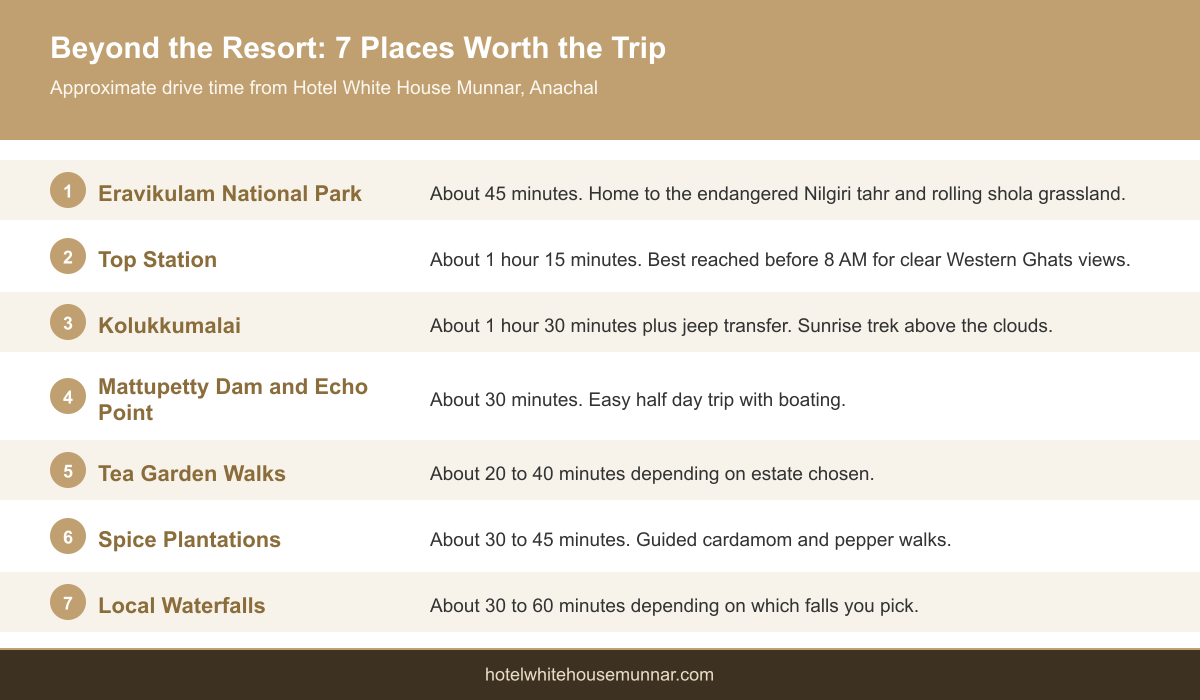
With seven different attractions to choose from, the easiest way to plan is to separate them into early starts and easier half days. Eravikulam and Kolukkumalai reward getting up before dawn, so pick one of those for your first full day, when you are likely to have the most energy. Save Mattupetty Dam, tea gardens and spice plantations for slower mornings later in your stay.
Weather matters more here than at a beach destination, since mist and rain can affect visibility at every viewpoint on this list. Check conditions the evening before with our front desk, and keep at least one flexible day in your plan so an early trek can be rescheduled if the forecast looks poor.
A Sample Two Day Plan
Day one: an early Eravikulam National Park visit in the morning, followed by lunch back at the property and a relaxed tea garden walk in the afternoon. Day two: the Kolukkumalai sunrise trek, followed by rest, then Mattupetty Dam and Echo Point later in the day if energy allows, or simply time at the pool. This pace covers the two most demanding outings and the two easiest without feeling rushed on either day.
A Sample Three Day Plan
Spread across three days, add Top Station and a spice plantation tour as a relaxed third day, with a waterfall stop worked in on whichever afternoon has a gap. This pace leaves more breathing room between the two early starts and suits families or anyone travelling with young children or older relatives, and it gives you a genuine buffer day if weather forces a change of plan partway through the trip.
Conclusion
None of these seven attractions require booking weeks in advance, and most can be added or swapped the night before based on weather and how you are feeling that morning. Treat this guide as a starting point rather than a fixed itinerary, and lean on our front desk to help fill in the gaps once you know roughly how many early starts you are willing to make. However you split your time, the places to visit near Hotel White House Munnar covered here give you a genuine range, from an early trek above the clouds at Kolukkumalai to a relaxed half day at Mattupetty Dam. Our front desk can help arrange transport and timing for any combination of stops. Check our rooms or reserve your stay and let us help you build the right itinerary around your visit.
Frequently Asked Questions
What are the best places to visit near Hotel White House Munnar?

How many days do I need to see everything on this list?
Which nearby attraction is best for an early morning trip?
What is the easiest half day trip from Hotel White House Munnar?
Can Hotel White House Munnar help arrange transport to these places?
Are these attractions suitable for families with children?
When is the best season to visit these Munnar attractions?
Do I need a guide for these Munnar attractions?
Is Hotel White House Munnar well located for exploring the area?