Candlelight & Private Dining Experiences at Hotel White House Munnar
 Services
A candlelight dinner munnar properties advertise is usually a photograph rather than a plan, which is why so many of them disappoint. The setting here genuinely helps: at 1,600 metres the evening arrives early, the air is cold and clear, and there is very little ambient light to compete with. What it needs is a small amount of organising, because an outdoor table in the hills depends on weather and the kitchen needs to know before service starts. This piece explains what a private dinner here actually involves, when to ask, and what happens when the cloud comes down at seven.
Key Takeaways
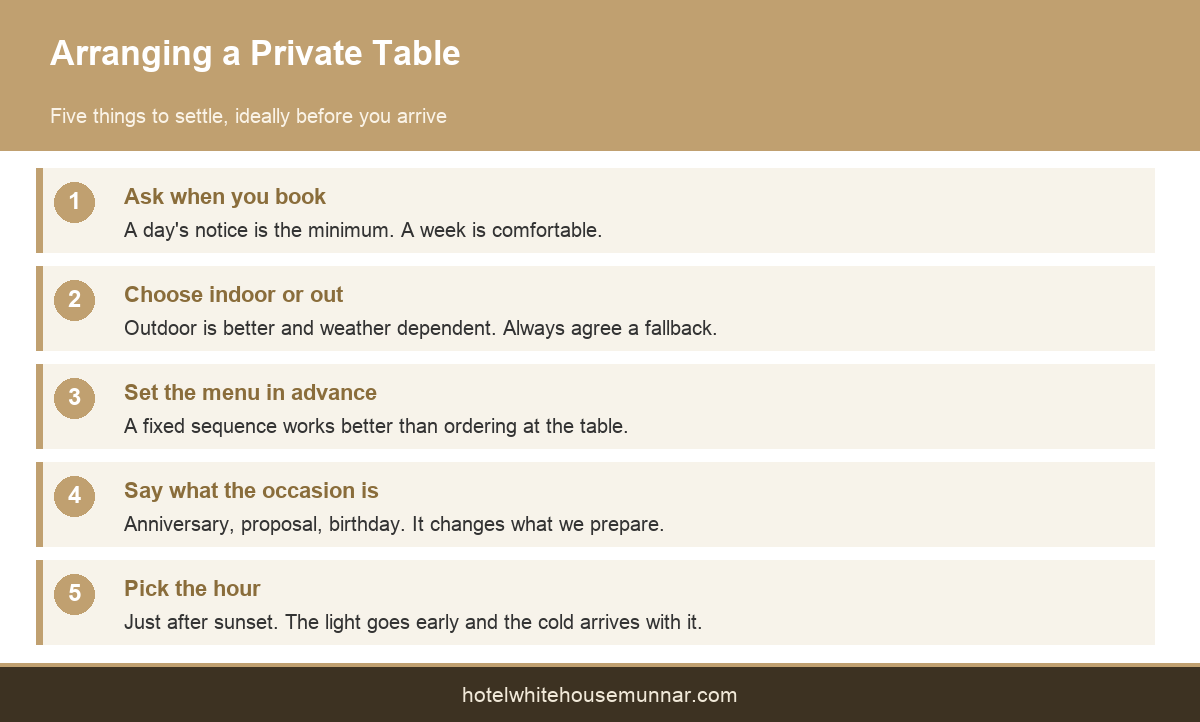
- Ask when you book, not on the evening. A day's notice is the practical minimum.
- Outdoor setups are better and weather dependent; always agree an indoor fallback.
- A fixed menu agreed in advance works better than ordering at the table.
- Just after sunset is the hour, because the light goes early behind the ridge.
Why the Setting Does Most of the Work
Evenings here have two qualities that are difficult to manufacture. The first is darkness: there is very little light pollution on this side of the hills, so candles actually read as the light source rather than a decoration.
The second is cold. Not uncomfortable, but enough that an outdoor table feels like an occasion rather than the default. A shawl and a warm dish do more for the atmosphere than any amount of decoration.
The valley in front of the property is the view, and it changes character completely as the light goes. Our write-up on where the light works best covers the same effect from a camera's point of view.
Guests staying in the categories that face the open side get a version of this from their own balcony, which our tree-facing room guide describes.
Indoor, Outdoor and the Weather Problem
Outdoor is better when it works and it does not always work. Cloud descends without warning here, and a drizzle that would be nothing in the afternoon becomes a real problem around a table set for two.
The answer is to plan both and decide at around five in the evening. An indoor table set apart from the main dining room, with the same menu and the same service, is not a consolation prize.
Between June and August, assume indoor and treat outdoor as the bonus. Our note on the wet months explains what those evenings are typically like.
From December to February, outdoor is reliable but genuinely cold. Ask for the earlier sitting and bring a layer; our checklist of what to bring covers what that means in practice.
Getting the Menu Right
A fixed sequence agreed in advance works better than a menu handed over at a candlelit table, where reading it is a nuisance and choosing takes the momentum out of the evening.
Three or four courses is the usual shape. It is worth including at least one regional dish, since that is the thing you cannot have at home; our regional food guide covers what suits a slower meal.
Dietary requirements need to be settled at the same time. A private table is the worst possible moment to discover a constraint, and our meat-free options note sets out what needs warning.
The broader range the kitchen can draw on is covered in our menu write-up, and the current positioning sits on the dining page.
Occasions, and Saying What It Is For
Tell us what the evening is for. An anniversary, a birthday, a first night of a honeymoon and a proposal all want different things, and the difference is entirely in the preparation rather than the price.
Proposals in particular need coordination rather than decoration: where the table sits, who is nearby, whether anyone is photographing, and what happens immediately afterwards. None of that can be arranged in the twenty minutes before dinner.
Cakes, flowers and a specific dish someone remembers are all straightforward with notice. Our celebration write-up covers what is usually asked for and what is actually possible.
For couples building a whole stay around this, the room matters as much as the table. Our comparison of the suite grades is the reference there.
Timing, Notice and Practicalities
The hour that works is just after sunset, which is earlier than most guests assume. Behind the ridge the light goes by around half past five, and by seven it is fully dark and cold.
A day's notice is the minimum and a week is comfortable, particularly in the December window covered by our festive season write-up, when the kitchen is busiest and the outdoor spaces are in demand.
Plan the day around it. A private dinner after a four in the morning start is a waste of both; our long-weekend plan shows where it fits without collision.
And say if you would rather it were quiet than elaborate. A number of guests want the table, the view and no ceremony at all, which is easy to arrange if somebody knows.
Conclusion
The ingredients for a good evening here are already in place: early darkness, clean cold air, almost no ambient light and a valley in front of you. What it needs from you is a day's notice, an agreed menu, an honest answer about the occasion and a fallback for the weather. Ask when you book rather than when you arrive, and the evening arrives prepared rather than improvised. Send us your dates and the occasion and we will take it from there.
Frequently Asked Questions
How far in advance should I ask?

What happens if it rains?
What time should the dinner be?
Can we choose the menu in advance?
Can you help with a proposal?
Is it very cold outdoors in the evening?
Can dietary requirements be accommodated?
Do you offer rooftop or in room options?