Trekking Trails Around Munnar for Every Fitness Level
 General
Trekking in Munnar covers a much wider range than the photographs suggest. The same hills that produce the long, hard ridge walks also hold gentle estate paths you can finish before breakfast, and the difference between a good day and a miserable one is usually just picking the right one. Staying in Anachal puts you within reach of both ends of that range. This guide sorts the options by effort rather than by fame, so you can match a trail to the least fit person in your group and still see something worth the early start. For the wider list of outings around the property, our round-up of what sits close to the resort covers the drives as well as the walks.
Key Takeaways
- Trails around Munnar range from 45-minute estate walks to two-day ridge crossings.
- Anything above Chokramudi needs a registered guide and, in places, a forest permit.
- September to March is the reliable window; monsoon paths are slippery and leech heavy.
- Book longer routes before you arrive, not on the morning you want to walk.
Short Walks You Can Do Straight From Anachal
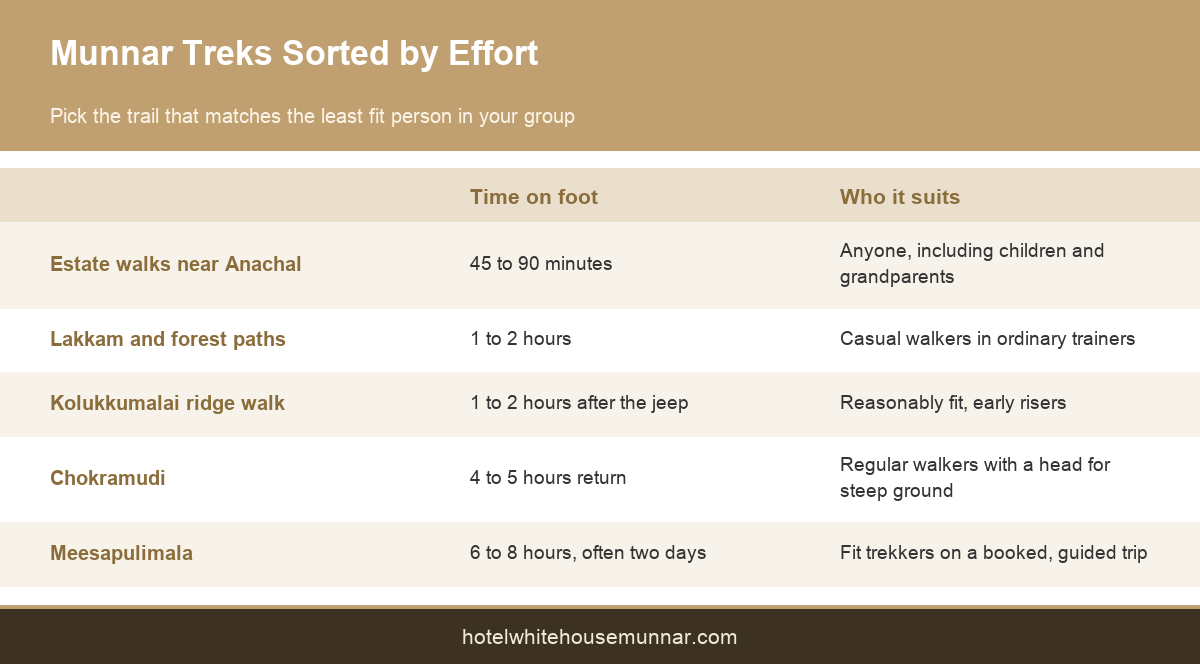
The easiest walking near the property does not need a guide, a permit or an early alarm. Estate roads run through the tea around Anachal, and a loop of 45 to 90 minutes gets you into open slopes with almost no climbing. These are cart tracks rather than trails, wide enough to walk two abreast and firm enough for ordinary shoes outside the monsoon.
This is the option for a first morning, for a group with mixed fitness, or for anyone who wants the view without committing a whole day to it. Our front desk can point out which tracks are currently in use by estate vehicles, which matters more than distance. Several of these loops appear in our list of things worth doing around the village.
If you want the same terrain with more structure, a guided estate walk turns the loop into a working tour of how the leaf is picked and graded. That is covered separately in our write-up on how the estates are toured, which explains what a plucking session actually involves and when the factories accept visitors.
Half-Day Trails: Lakkam, Chokramudi and the Forest Paths
A step up from the estate loops, the half-day routes involve real climbing but still get you back for lunch. The walk in to Lakkam is short and shaded, uneven in places and worth proper shoes; it pairs naturally with the other falls covered in our comparison of the cascades nearby.
Chokramudi is the honest half-day climb of the area. It is four to five hours return on steep grass and rock, with a summit that looks straight across at Anamudi. There is no shelter on the way up, so it is a morning trip rather than an afternoon one, and it should not be attempted after heavy rain when the grass slopes hold water.
Forest paths on the fringes of the protected areas are a different matter again. Anything inside a reserve boundary is controlled by the state forest department, which sets access, timings and guide requirements. Do not assume a path is open because a map shows it.
The Long Ones: Meesapulimala and the Ridge Routes
Meesapulimala is the serious trek in this landscape. It runs across a series of grassy summits in the second highest range south of the Himalayas, takes six to eight hours in a single push, and is more often sold as an overnight trip with a camp at Rhodo Valley. It is booked, guided and capped, not something you walk up to and join.
Anamudi itself, the highest peak in the region at 2,695 metres, sits inside the national park and is closed to general trekking. Guests often ask about it after reading the official background on the peak; the practical answer is that you view it from Chokramudi or from inside the park rather than climb it.
The pre-dawn ridge walk above the tea at Kolukkumalai belongs in this group only because of the hour it demands. The walking is short once the jeep drops you, but the day starts at three in the morning. Our first-timer write-up on that pre-dawn run sets out what the vehicle stage is actually like.
Guides, Permits and What You Cannot Do Alone
The rule of thumb is simple. Estate tracks and short forest walks need nobody. Anything that crosses into a reserve, gains serious height, or runs into the evening needs a registered guide, and in several cases a permit issued on the day for a fixed number of walkers.
Guided trips are not a formality. On grass slopes above 2,000 metres the path disappears in mist within minutes, and the guides carry the route knowledge that a phone map does not. Kerala Tourism publishes the current position on organised walking in the state on its trekking pages, which is the safest place to check before you commit.
Book these through the front desk rather than a roadside agent. We deal with the same operators repeatedly, which matters when a group is capped and the slot is gone by seven in the morning. It also means someone at the property knows where you have gone.
Season, Kit and Timing
September to March is the dependable window. The ground has drained after the south west monsoon, the grass is still green, and visibility from the ridges holds through the morning. By late February the slopes turn straw coloured and the middle of the day gets genuinely hot on exposed ground.
Monsoon walking is possible on the short estate loops and unwise on anything longer. Paths turn to running water, leeches are constant in the shola forest, and the views that justify the climb are simply not there. Our note on travelling through the wet months covers what the roads are doing at the same time.
Kit is unglamorous and matters. Closed shoes with real grip, a light waterproof whatever the forecast says, more water than you think, and something warm for the summit where the wind does not stop. Full layering advice sits in our checklist of what to bring.
Conclusion
There is a walk here for almost every level of fitness, which is the part most itineraries miss. A guest who has never walked a hill can still spend a morning on the estate tracks and come back with the same light on the same slopes that the ridge walkers went out at four in the morning for. Decide honestly what your group can manage, book the longer routes before you travel, and let us know at the front desk which one you have chosen. If you would rather build the whole trip around walking, talk to us about dates and we can shape the stay around the mornings that matter.
Frequently Asked Questions
Is trekking in Munnar suitable for beginners?

Do I need a guide for every trek?
When is the best season for walking in these hills?
How hard is the Meesapulimala route?
Can I climb Anamudi?
Are the trails safe during the monsoon?
What should I wear on a longer walk?
Can the property arrange a walk for us?