Corporate Offsites & Team Retreats at Hotel White House Munnar
 Services
A corporate offsite venue munnar teams travel four hours to reach has to justify the journey, and the ones that do are the ones that stop pretending to be a conference centre. The value here is not the projector; it is that the team is somewhere with no distractions, eating together three times a day, with an afternoon outdoors between sessions. This piece covers what to schedule and what to abandon, the connectivity question that every organiser asks first, how many people this actually works for, and the specific mistakes that turn a good offsite into an expensive week of meetings in a colder room.
Key Takeaways
- One serious working session a day, in the morning. Afternoons belong outdoors.
- Connectivity is adequate for calls and documents, not for a full remote conference.
- Room availability caps the group size, not the size of the meeting space.
- Dinner together every night is where an offsite actually earns its cost.
Retreat, Not Conference
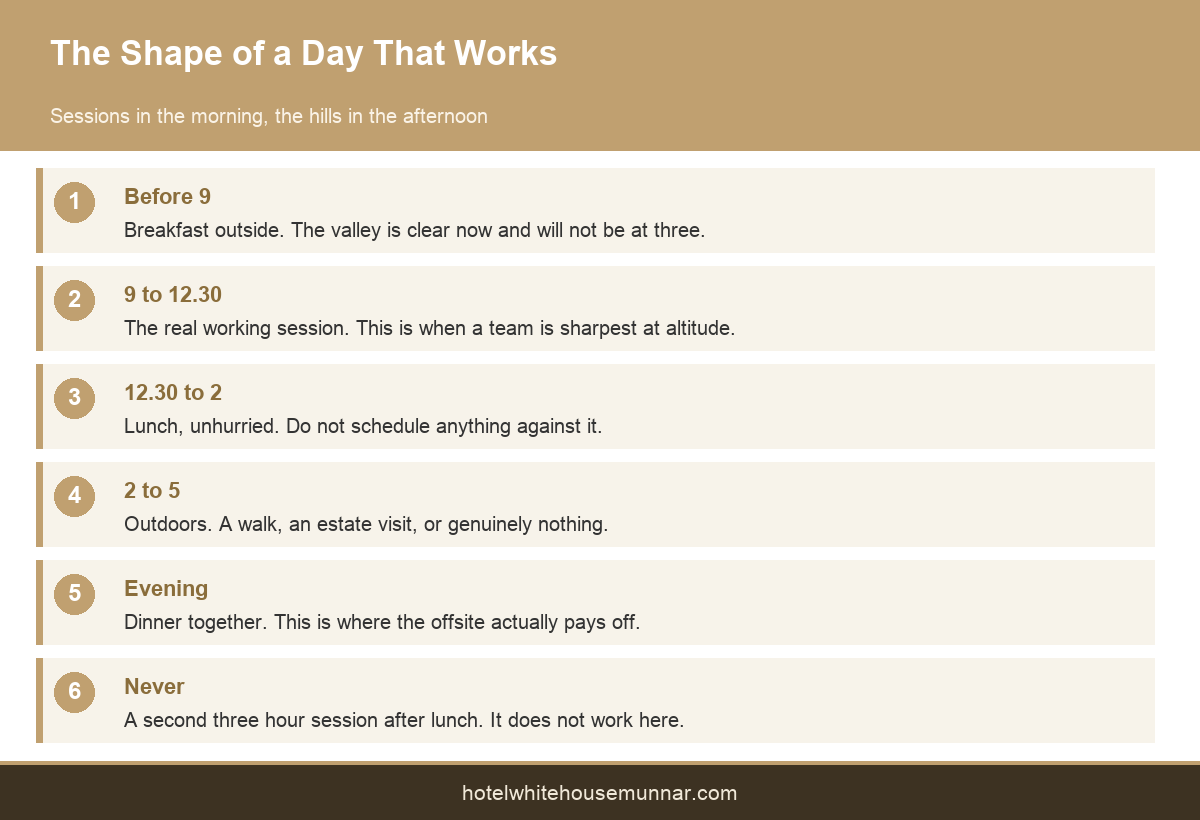
The single biggest determinant of whether an offsite works is whether the agenda respects where it is happening. Two three hour sessions a day in a hill station is a waste of the location and of everybody's attention.
Mornings here are clear, cool and genuinely productive. Afternoons cloud over, energy drops and the room gets stuffy. Schedule accordingly rather than fighting it.
That leaves the afternoon for the reason you came: a walk, an estate visit, or an unstructured few hours. Our trail write-up sorted by effort lists routes that fit an afternoon without needing an expedition.
The evenings are where the actual work of a team offsite gets done, which is a case for one long dinner rather than a scheduled activity.
Connectivity, Honestly
This is the first question every organiser asks and it deserves a straight answer. Connectivity at the property is good enough for email, documents, and video calls with a handful of participants. It is not a substitute for an office.
If half your team is joining remotely for a full day, this is the wrong venue and no hill property will be the right one. If the team is here and occasionally needs to dial out, it works.
Guests who work from here for longer periods manage fine, which our write-up on working from the hills covers in practical detail, including the parts that do not work.
Mobile signal is patchy once you leave the property, particularly on the higher routes. Plan the afternoon on the assumption that people are unreachable, which is usually the point.
How Many People This Suits
Small enough that everyone eats at one table is the sweet spot, which in practice means somewhere between eight and thirty people depending on how you use the rooms.
The ceiling is set by room availability rather than by meeting space. Our guide to booking many rooms at once covers how the room block works and what notice it needs.
Above that scale, the offsite starts behaving like a conference: multiple tables, a schedule nobody reads, and a venue chosen for capacity rather than character. That is a different kind of event and a different kind of property.
For a leadership team of six to ten, this is close to ideal, and the room categories in our suite grade comparison matter more than the meeting room does.
What to Schedule Outdoors
Something shared, physical and not competitive. The estate walks near the property are the reliable choice: level enough for anyone, close enough to fit an afternoon, and conversation friendly.
An estate or spice tour works well as a structured alternative, because it gives the group a common subject that has nothing to do with work. Our estate visit guide and plantation write-up cover both.
Avoid scheduling a four in the morning start into an offsite. The pre dawn trips in our first-timer write-up are magnificent and they will cost you the following morning's session entirely.
Leave one afternoon completely unscheduled. It is the single most appreciated item on any offsite agenda and it costs nothing.
Logistics and Mistakes to Avoid
Transport first. The team will arrive across a four hour drive, not together, and the first evening should be an arrival dinner rather than a session. Our route guide up from the coast gives realistic timings.
Settle catering and dietary requirements in advance rather than at the first meal. A single sitting with a fixed menu is easier for the kitchen and faster for the group, and our meat-free options note covers what needs notice.
Do not book the shortest possible trip. Two nights means one usable day and a great deal of driving for it. Three nights is where an offsite starts to pay for itself.
And name one organiser. The rest is in our events space guide, which covers the running of a group event in more detail.
Conclusion
An offsite here works when the agenda is honest about what a hill station is for: one sharp working session in the morning, the afternoon outdoors, and dinner together every night. It fails when someone tries to run an office day at 1,600 metres. Book three nights rather than two, block the rooms early, settle catering in advance, and leave one afternoon completely empty. Tell us your dates and headcount and we will tell you honestly whether the group you have in mind fits.
Frequently Asked Questions
Is the connectivity good enough for work?

How many people can you host for an offsite?
How should we structure the day?
How long should the offsite be?
What should we do in the afternoons?
Is there a conference room?
Can you cater for the whole group at once?
What is the most common mistake?