Sustainability & Eco-Friendly Practices at Hotel White House Munnar
 Services
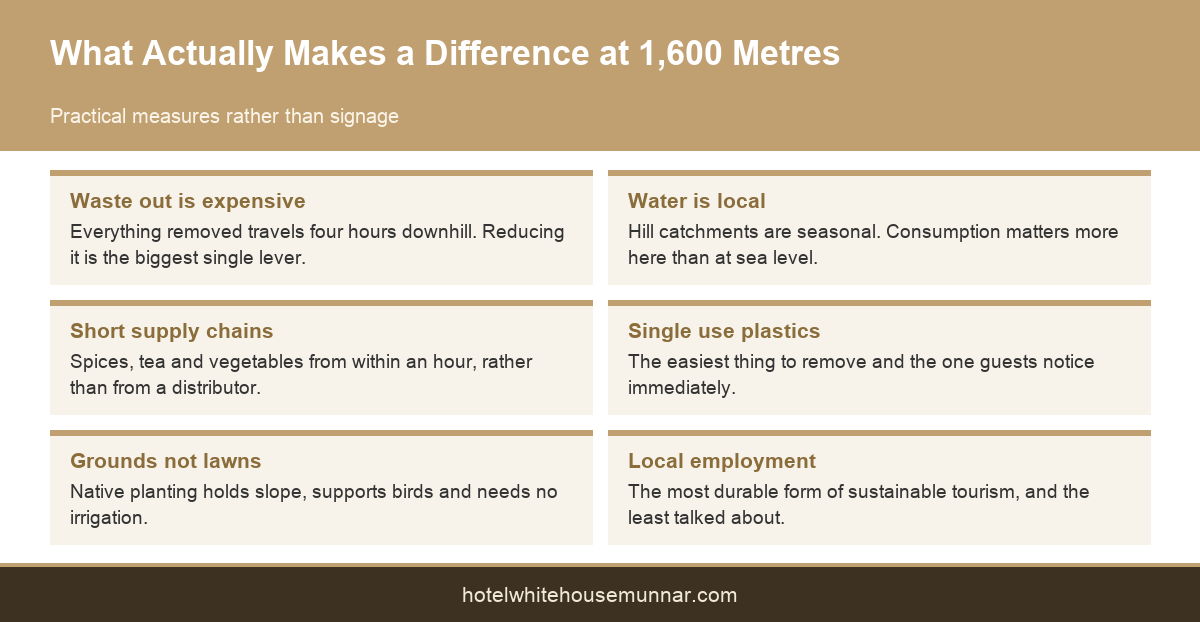
Calling somewhere an eco friendly resort munnar visitors can trust is easy and mostly unverifiable, so this page is deliberately specific about what a property at 1,600 metres can actually do and what it cannot. The constraints here are real: everything that leaves as waste travels four hours downhill, water comes from seasonal hill catchments, and the surrounding slopes are a working agricultural landscape rather than a wilderness. That shapes which measures matter and which are decoration. It also gives guests a few genuinely useful things to do, which is more than most sustainability pages manage.
Key Takeaways
- Waste reduction is the single largest lever at this elevation, because removal is costly.
- Water comes from seasonal hill catchments, so consumption matters more than at sea level.
- Short supply chains cut transport and support the local agricultural economy.
- Guests can help meaningfully, mostly by reusing towels and refusing single use plastic.
Why the Constraints Are Different Up Here
A city hotel sends waste a few kilometres. Everything that leaves a hill property travels the same four hours down that guests drive up, which makes reduction the most effective measure available rather than a virtuous extra.
Water is the second constraint. Hill catchments are seasonal, full after the monsoon and much thinner by March, as our month-by-month climate note implies.
The third is that this is not wilderness. The slopes around here are a working landscape of tea and spice, which our estate visit guide and plantation write-up describe. Sustainability here means working with that, not pretending it away.
Kerala's own responsible tourism programme is built around exactly that premise.
Waste, Water and Energy
Single use plastics are the easiest thing to remove and the change guests notice first. In room bottles, straws and sachets are the usual culprits.
Linen and towel reuse over a multi night stay makes a genuine difference at altitude, where laundry is water and energy intensive and drying is slow in humid conditions.
Food waste is the other large stream, and it is managed better by planning than by disposal, which is one reason a group meal is arranged as a single sitting with known numbers rather than an open service.
Hot water at this elevation costs real energy. Nobody is asking guests to take cold showers in a place where evening temperatures approach single figures, but shorter ones help.
Sourcing Locally Where It Is Genuine
The hills produce spices, tea and a set of temperate vegetables well, and produce rice, pulses and fish not at all. Being honest about that split is the difference between local sourcing and a marketing claim.
Our kitchen sourcing write-up sets out exactly what comes from within an hour and what comes up from the plains.
Buying from nearby growers keeps money in an agricultural economy that has been under pressure for years, and it shortens the transport chain at the same time.
For guests, the practical version is to order the seasonal dish and to buy spices at the farm gate rather than in a city later.
The Landscape Around the Property
Native planting holds slope, supports birds and needs no irrigation, which is a better use of grounds at this elevation than a manicured lawn that has to be watered through the dry months.
The surrounding shola forest fragments and grasslands are genuinely rare habitats, protected in places by the state forest department and visible at the reserve described in our visitor guide to the protected park.
Guests who walk here have a direct role in keeping it intact: staying on marked paths, carrying rubbish out, and not feeding anything. Our trail write-up sorted by effort covers where the sensitive ground is.
The same applies at the falls and viewpoints, described in our comparison of the cascades, which suffer visibly from litter in peak weeks.
What Guests Can Actually Do
Reuse towels and linen over a multi night stay. It is the single most effective thing a guest can do and it costs nothing.
Carry a refillable bottle. It removes the largest single stream of plastic that a visitor generates here, and refills are straightforward.
Take your rubbish back down with you from viewpoints and trails. There is no collection at most of them and what is left stays.
And buy locally rather than at an airport on the way home. Spices, tea and craft bought here put money where the landscape is maintained. Our round-up of what is nearby covers where to find them.
Conclusion
Sustainability at this elevation is unglamorous and mostly logistical: less waste to move, less water drawn from seasonal catchments, shorter supply chains, native planting, and employment that stays local. None of it photographs well and all of it matters more than a sign asking you to consider the environment. If you want to know exactly what we do on any of this, ask rather than taking a page at face value. Our contact page is open, and our direct booking pillar covers how the property runs more broadly.
Frequently Asked Questions
What makes a hill property eco friendly?

Why does waste matter more here?
Is water a real constraint?
What is actually sourced locally?
What can I do as a guest?
Are the surrounding hills protected?
Does the property use single use plastic?
Is sustainable tourism a formal programme in Kerala?