Munnar Trip Planning Guide: Everything to Sort Before You Travel
 General
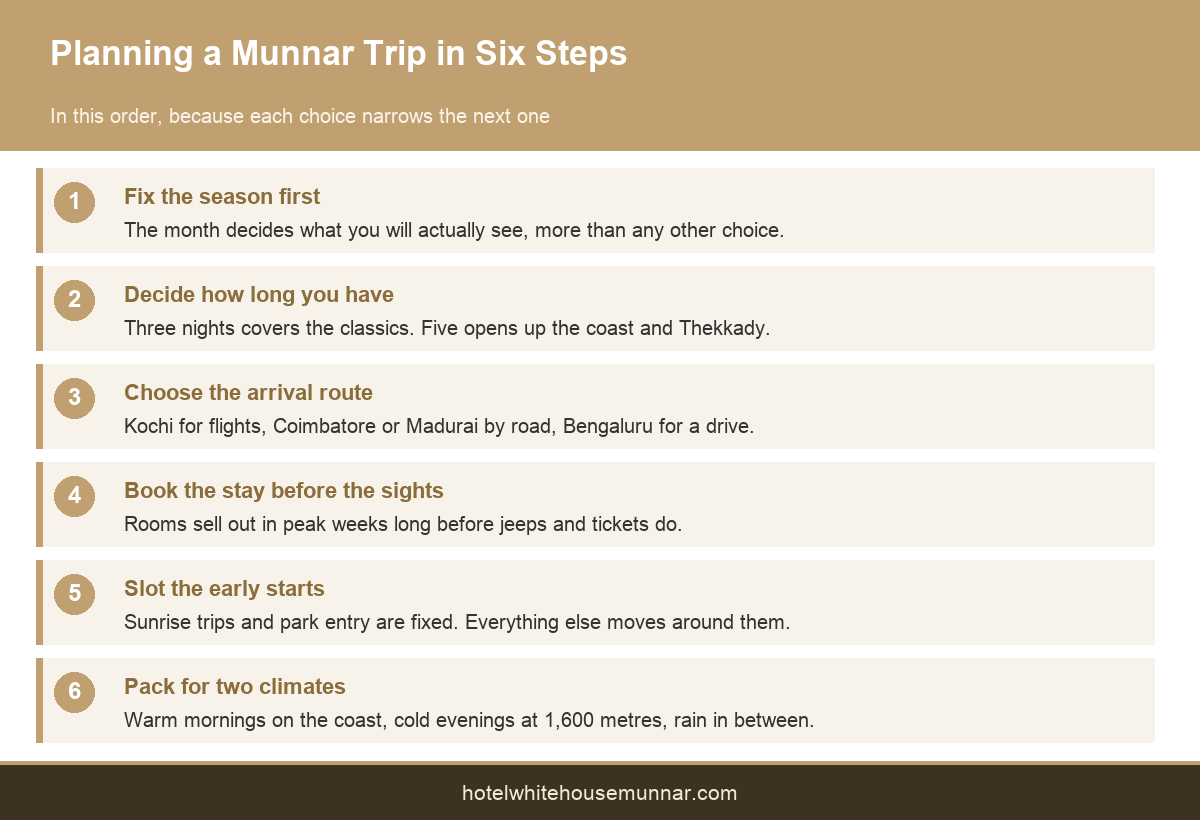
Most disappointing trips to these hills are not caused by the weather. They are caused by a plan built in the wrong order, where the flights were booked before anyone checked what the month actually looks like, or where three days were split across so many viewpoints that the whole holiday was spent in a car. This munnar trip planning guide sets the decisions out in the order they should be made, from the property's point of view in Anachal rather than a tourist board's. Each section links to a deeper piece if you want the detail, and every drive time here is measured from where you would actually be sleeping, not from the town centre.
Key Takeaways
- Fix the month before anything else; it decides more than any other single choice.
- Three nights is the working minimum for the main sights without a rushed schedule.
- Kochi is the usual arrival airport, roughly four hours away by road.
- Early starts are non negotiable for the sunrise trips and the national park.
Start With the Month, Not the Dates
Everything else follows from when you come. September to March gives you clear mornings, green slopes and reliable road conditions, which is why it carries the highest rates and fills first. April and May are hot at lower elevations but still pleasant up here, with noticeably better availability.
June to August is the south west monsoon. The hills are at their greenest and quietest, the rates drop, and long walks become impractical. It suits a certain kind of guest very well and frustrates another completely. Our month-by-month climate note sets out what each part of the year actually delivers.
There is also a twelve year event worth knowing about. The neelakurinji shrub carpets these slopes in blue only once in over a decade, and the background on that flowering cycle explains why the crowds arrive when it does. In every other year the hills are green rather than blue, which is the safer expectation to travel with.
If you already have fixed leave dates, work the other way and read our season by season overview to see what that particular window will and will not give you.
One practical note on the shoulder weeks. Late September and early October, and again the first half of March, tend to give the best ratio of clear mornings to crowds and rates. The rain has usually finished or not yet started in earnest, the slopes are still green, and the school holiday surges have passed. Availability in those windows is genuinely open rather than technically open at a premium, which is a different thing entirely when you are trying to book a specific room type for a specific set of nights.
How Long to Stay
Two nights is the most common booking and the most commonly regretted one. With arrival and departure drives, two nights leaves a single usable day, which forces a choice between the park, the dam circuit and a sunrise trip rather than letting you do all three.
Three nights is the working minimum. It gives one early start, one relaxed day and one flexible day that absorbs rain or a late arrival without wrecking the plan. Our long-weekend plan lays that out hour by hour.
Five nights changes the character of the trip rather than just extending it. You get the hills without hurry and enough room to pair them with the backwaters or Thekkady on the way in or out, which is the shape our longer route across the state follows.
There is a third pattern worth naming, because a growing number of guests arrive on it. A week or more, working through part of it, treating the hills as somewhere to live briefly rather than tour. Connectivity holds up well enough here for that to be realistic, and the rhythm of it is completely different from a sightseeing trip. Our write-up on working from the hills covers what that actually looks like in practice, including the parts that do not work.
Getting Here
Kochi is the default arrival point. The international airport at Nedumbassery sits roughly four hours away by road, and the drive climbs steadily through rubber and spice country before the tea begins. Our route guide up from the coast covers taxis, buses and what the road is like at each stage.
By road from further out, Coimbatore and Madurai are the shortest approaches from Tamil Nadu, while Bengaluru is a long but popular self drive. The overland drive write-up covers the route choices and where the sensible overnight stops sit.
For a straight comparison of how far away everything is, our table of driving distances and times lists the usual origin cities against realistic hill road timings rather than optimistic map estimates.
Where You Sleep Changes the Itinerary
Anachal sits away from the congestion of the town centre while staying inside easy reach of the main sights. That trade matters more than it sounds. A stay in town means noise and traffic but short hops; a stay out here means quiet, cooler nights and slightly longer drives to the busiest attractions.
Room choice affects the trip too, particularly for families and for anyone planning early starts. Our breakdown of which layout suits which group size and the comparison of the suite grades are the practical references there.
If the view is the point of the trip rather than a bonus, the room category matters more than the property. The guide to the tree-facing category explains what you actually see from each aspect, and all our room types sit together on one page.
Building the Days
Fix the immovable things first. The national park runs on set entry timings and a shuttle system, and the sunrise trips leave in the dark. Everything else can be arranged around them. Our visitor guide to the protected park and the pre-dawn jeep write-up carry the current timing detail.
Group the rest geographically rather than by interest. The dam, the lake and the echo point sit on one road and make a natural half day, covered in our half-day lake route. The estate visits and the spice farms sit in another direction entirely.
Leave one afternoon genuinely empty. Cloud rolls in without much warning here, and the guests who enjoy the trip most are the ones with somewhere to be when it does. The wider list of what is nearby is useful for filling a gap at short notice.
Be realistic about how much driving a day can hold. Hill roads average far slower than the distances suggest, and three separate destinations in one day usually means five hours in a vehicle for perhaps ninety minutes of actually looking at anything. Two anchors a day, one of them early, is the pattern that consistently works. If the group includes small children or anyone who tires easily, make it one.
Budgeting Honestly
Room rate is only part of it. Jeep hire for the high routes, park entry, guided estate walks and boat rides all sit outside the tariff, and they add up faster than most first time visitors expect over three days.
Rates themselves swing hard by season. The same room in a wet August week and a dry December one are different propositions entirely. Our note on what a rate actually covers sets out what is included before you start comparing numbers between properties.
Star ratings are a poor guide to value in this market, where the label is applied inconsistently. Our explainer on how the grades are used here is worth five minutes before you filter a listing site by stars.
What to Bring
You are packing for two climates on the same trip. The coast is hot and humid; at 1,600 metres the evenings are genuinely cold, and the gap catches people out every season.
Rain is possible in almost any month, not only during the monsoon, and afternoon cloud can turn to drizzle within minutes on the ridges. A light waterproof earns its space in the bag year round.
Footwear does more work than anything else you bring. Estate paths, wet steps and the walk in to the falls all reward grip. The full list sits in our checklist of what to bring.
Eating, and Why It Needs Planning Too
Dining is one of the easier things to get wrong here, because the town empties earlier than visitors expect and the drive back in the dark on estate roads is not something most guests want to repeat. Eating where you are staying is the default rather than a compromise, and it is worth checking what a property actually serves before you book.
On our side that means a multi cuisine kitchen rather than a single fixed menu, which matters over three or four consecutive nights. Our full menu write-up covers the range, and the regional food guide explains which local dishes are worth ordering while you are in the state.
Say anything dietary at the time of booking rather than at the table. Vegetarian is straightforward, but strict vegan, Jain and allergy requirements need the kitchen to know in advance, particularly on a busy weekend. Our note on meat-free options sets out what can be arranged with notice.
If part of the trip is a celebration, say that too. A quiet table set apart from the main room is easy to arrange with a day's warning and impossible to conjure at eight in the evening. The private table write-up covers how those evenings are usually put together.
Travelling With Children, Parents or a Group
The plan changes shape depending on who is coming. With small children, the early starts stop being realistic and the pool becomes the most used facility on the property rather than an afterthought. Our write-up on the deck and water and the on-site amenities page are the practical references there.
With older parents, the constraint is usually walking distance and steps rather than stamina, and the good news is that a large share of what people come here for can be seen from a vehicle or a short level path. Our accessibility write-up sets out which sights work and which do not.
For a larger party, the arithmetic is different again. Room blocks, a single dining sitting and shared transport all need arranging in advance rather than assembled on arrival, which is what our guide to booking many rooms at once is for.
Booking, and What to Sort Before You Arrive
Rooms go first in peak weeks, long before jeeps and tickets. If your dates are fixed, secure the stay and treat the rest as arrangeable. Check dates and reserve is the quickest route, and our walk-through of the direct process explains what happens after you send an enquiry.
Book the capped activities before travelling. The sunrise jeeps and guided walks run on limited slots that are gone by breakfast, and arranging them through the front desk means someone here knows your plan for the day.
Finally, tell us what you are trying to do. A honeymoon, a first trip with a toddler and a walking holiday all need different rooms, different timings and different advice. Get in touch with the front desk before you finalise and the rest of the plan gets much easier.
Conclusion
Planning for these hills rewards a small amount of order. Choose the month, then the length, then the route, then the room, and by the time you reach the day by day itinerary most of the hard decisions have already been made for you. The mistakes that spoil trips here are almost always the reverse: dates locked first, then a scramble to fit everything into a single usable day. Work through the sections above in order, use the linked guides where you need the detail, and talk to us about your dates once the shape of the trip is clear.
Frequently Asked Questions
How many days do I need in Munnar?

Which month is best to visit?
Which airport should I fly into?
Is it worth staying outside the town centre?
What should I book before I arrive?
How much should I budget beyond the room rate?
Do I need warm clothing?
Can the property help build the itinerary?