Restaurant in Munnar with Multi Cuisine: A Complete Dining Guide
 General
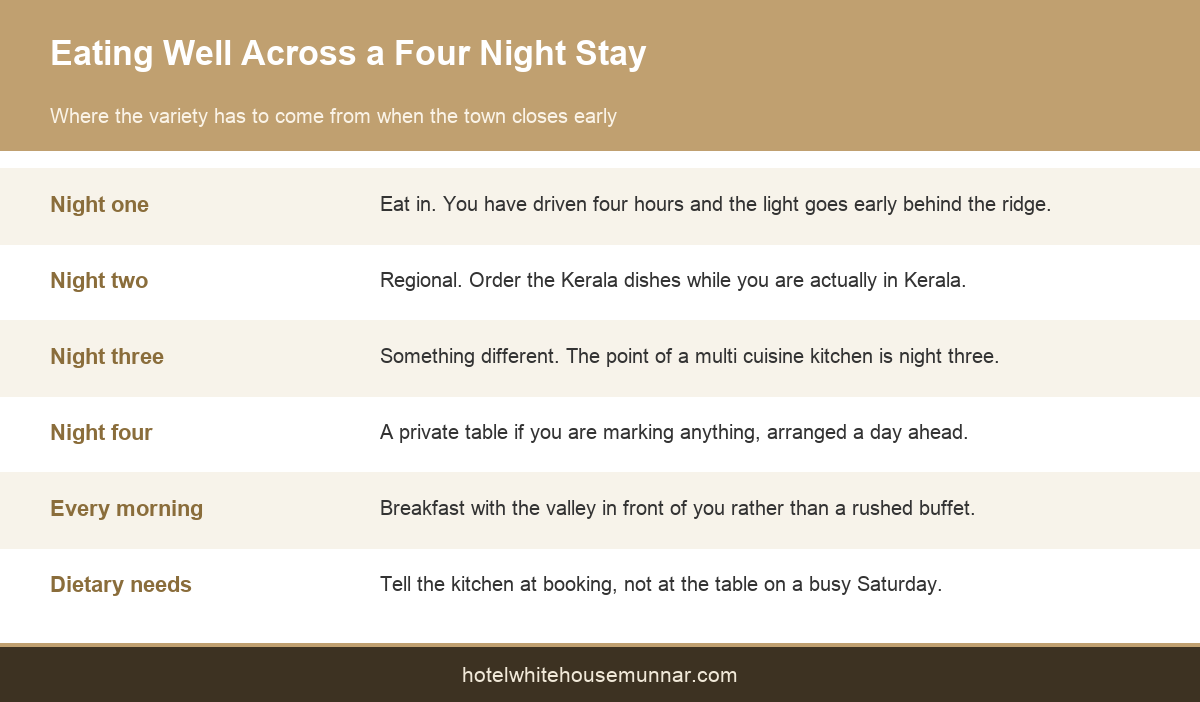
Finding a restaurant in munnar with multi cuisine matters more than it would in a city, and for an unglamorous reason. The town winds down early, the estate roads are dark and winding after eight, and most guests eat where they are staying for at least three of four nights. That turns the kitchen from a convenience into one of the things that decides whether the trip was good. This guide covers what a hill station kitchen can realistically deliver, how to plan meals across a multi night stay so the variety holds, what the regional food is actually worth ordering, and how to handle dietary requirements without a difficult conversation at the table.
Key Takeaways
- Most guests eat in for at least three of four nights; the town closes earlier than expected.
- Multi cuisine matters over consecutive nights, not on any single one.
- Order the Kerala dishes at least once; they are the reason to eat here rather than anywhere.
- Flag dietary needs at booking, when the kitchen can plan rather than improvise.
Why Dining Is a Booking Decision Here
In a city, where you sleep and where you eat are separate decisions. Here they are the same one. The drive back from town on unlit estate roads after a late dinner is the part guests only do once, and after that they eat in.
That makes the range of a kitchen worth checking before you book rather than after. A single fixed menu is perfectly pleasant on night one and wearing by night three, which is the real argument for a multi cuisine operation rather than a marketing phrase.
It also means opening hours matter. Guests coming off a four hour drive, described in our route guide up from the coast, frequently arrive after normal service would have closed elsewhere.
Our own kitchen is one of three facilities covered in the facilities write-up, and the dining page carries the current menu positioning.
What Multi Cuisine Actually Means
Used honestly, it means the kitchen can cook competently across South Indian, North Indian, Chinese and Continental rather than listing all four and doing one. The test is not the menu length. It is whether the third night still feels like a choice.
For a family with a mix of ages, this is the practical requirement. Grandparents want familiar regional food, children want something plain, and somebody always wants noodles. A kitchen that can do all three at one sitting removes an argument.
For couples it works differently: the range is what allows a quiet dinner to be different from the previous one without leaving the property. Our private table write-up covers how those evenings are set up.
The detail of what our own kitchen puts out, and where the 101 tastes positioning comes from, sits in our menu write-up.
The Regional Food Worth Ordering
You are in one of the most distinctive food regions in India, and it would be a waste to spend four nights eating things you could have at home. Coconut, curry leaf, tamarind and black pepper run through almost everything, and the vegetarian repertoire is unusually deep.
A sadya, served on a banana leaf with a sequence of small preparations, is the set piece. It is normally a festival meal but can be arranged with notice, and it is covered in our regional food guide.
Kerala Tourism's own state food overview is a good primer if you want to know what you are ordering before you sit down.
Spices here are not an abstraction either. Cardamom, pepper and clove grow within an hour of the property, which our plantation visit guide covers, and the connection between the field and the plate is unusually short.
Breakfast, and Why It Is the Best Meal Here
Breakfast is the meal the landscape actually improves. Mornings are clear when afternoons are not, the valley is usually visible, and the temperature is at its most pleasant for sitting outside.
It is also the meal most affected by your itinerary. A pre dawn trip means you are back for a late one, and a park morning means you want it early and quick. Telling the front desk the night before solves both.
Our morning meal write-up covers what is served and how it changes for guests on early starts, which the long-weekend plan builds around.
Packed breakfasts are worth asking about if you are leaving before service. They are straightforward to arrange with a day's notice and impossible at four in the morning.
Vegetarian, Vegan and Other Requirements
Vegetarian is entirely standard here and needs no special arrangement; a large share of the regional repertoire is vegetarian by default rather than by substitution.
Vegan, Jain and specific allergies do need notice. Coconut oil and coconut milk are everywhere, ghee appears in places you would not expect, and a busy Saturday evening is the wrong moment to discover a constraint.
Tell us at the time of booking. Our note on meat-free options sets out what can be arranged with warning and what genuinely cannot, which is a shorter list than most guests expect.
For guests travelling with young children, plain options are always available, and it is worth reading our write-up on room layouts for families alongside this, since in room dining changes what is practical.
Where the Ingredients Come From
A hill kitchen at 1,600 metres has a supply chain that a city restaurant does not. Some things arrive from the plains, some grow within a few kilometres, and the seasonal difference between them is noticeable on the plate.
That local share is the more interesting part, and it is why the vegetable dishes here often taste better than their equivalents at sea level. Our kitchen sourcing write-up covers what is grown nearby and what is not.
It also connects to a wider point about how the property runs, which our environmental practices note sets out, and to the state's own responsible tourism programme.
The practical upshot for a guest is simple. Ask what is good that week rather than ordering from habit, and the kitchen will usually steer you well.
Celebrations and Private Dining
A surprising number of stays here mark something: an anniversary, a birthday, a honeymoon, occasionally a proposal. All of those are easier to arrange well with a day's notice and nearly impossible to conjure at eight in the evening.
A table set apart, a cake, a particular dish someone remembers from a previous visit; none of it is complicated, and all of it needs the kitchen to know. Our celebration write-up covers what is usually asked for.
For larger groups, dining is one of the harder parts of the logistics rather than the easiest. A single sitting for twenty needs planning, which is what our guide to booking many rooms at once is for.
And for anything at the scale of a reception, the banquet space rather than the restaurant is the right room. Our events space guide covers that side.
Eating Out, and When It Is Worth It
None of this means you should never leave. Munnar town has genuinely good small places, particularly for breakfast and for tea, and a morning in town is worth building into a longer stay.
The practical rule is lunch rather than dinner. Eating out at midday works with the driving you are already doing; eating out at night adds a dark drive back to the end of the evening.
If you are out for the day around the dam or the lake, plan the meal into the route rather than hoping. Our half-day lake route and the round-up of what is nearby note where the options thin out.
Carry water and something to eat on any early start. On the pre dawn runs described in our first-timer write-up there is nothing open at four in the morning.
Conclusion
Dining is not a side note on a hill station trip; over four nights it is one of the two or three things that decide how the stay felt. Check the range of the kitchen before you book rather than after, order the regional food at least once, flag any dietary requirement while someone still has time to plan for it, and treat breakfast as the meal the setting actually improves. If you are marking an occasion, tell us when you confirm your dates and we will have something arranged rather than improvised.